
Angkor Wat (“City of Temples”) was built in the early 12th century by King Suryavarman II as both a state temple and his eventual mausoleum. Located on a site measuring 162.6 hectares (1.6 km2; 401.8 acres), it is hailed as the largest religious structure in the world and depicted as a part of the Cambodian national flag.

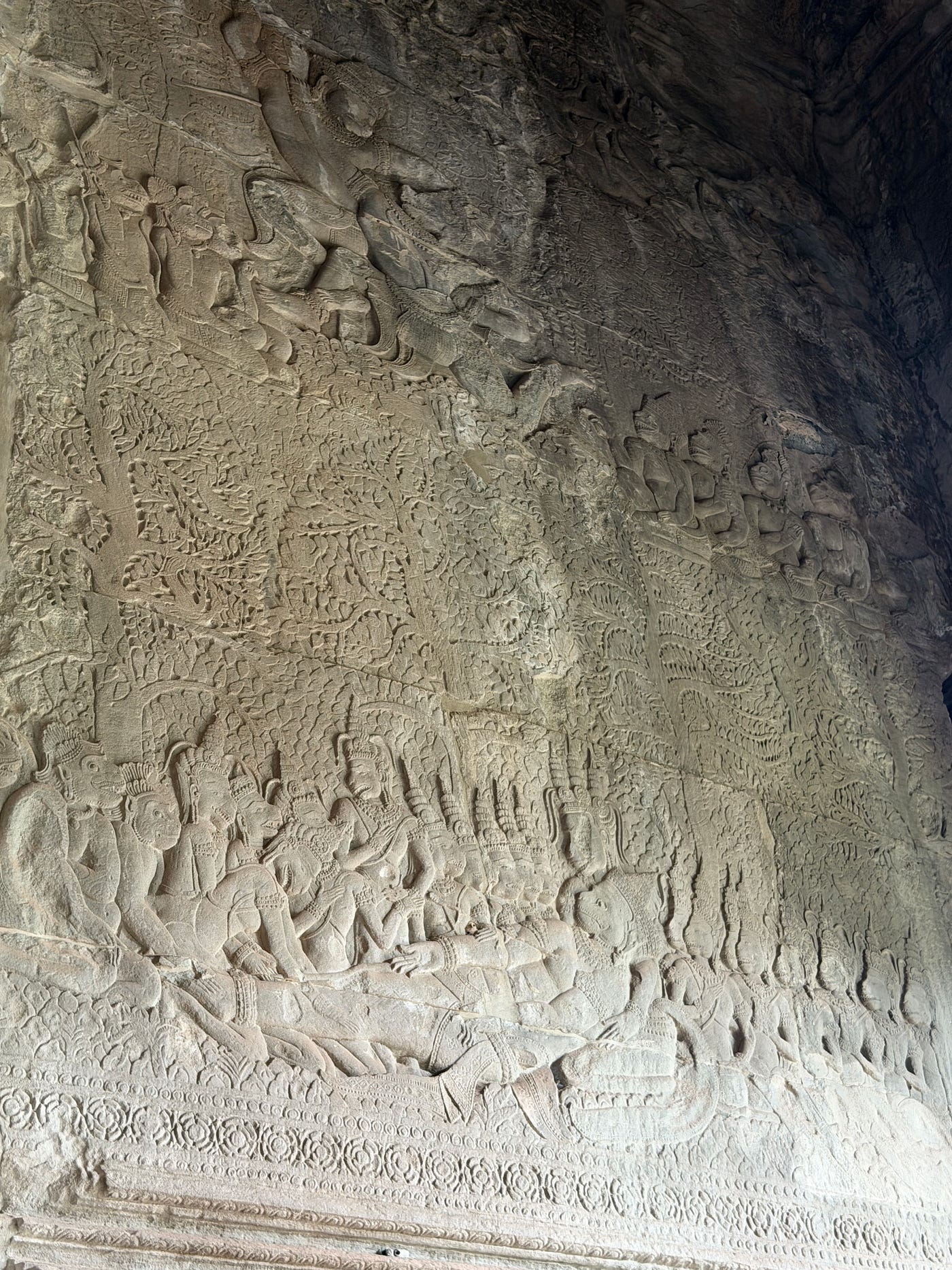
Its five central towers echo the mythical Mount Meru, the abode of gods. Its vast moat mirrors the cosmic ocean believed to cradle the world. Every axis, corridor, and carving carries a hidden logic, some scholars say even numerological and astronomical meaning. The walls are stories etched in sandstone- narratives drawn from epics like the Mahabharata and the Ramayana, whispering tales of gods, heroes, wars and ancient kings. The detailing is incredibly beautiful.
While there are no scientifically proven healing properties associated with this important location, many visitors report feeling a sense of deep peace or even transformation when visiting Angkor Wat. Though instruments may not be able to measure any kind of force fields, etc., what people are experiencing may be attributed to several unsolved mysteries that are at the heart of this enigmatic structure. These mysteries include the following:
1) How was Angkor Wat built? Even though the structures were erected over 900 years ago, experts still don’t understand how the complex was constructed. The site is made of massive stone structures covering more than 500 acres and includes intricate carvings in huge stone blocks plus elaborate hydraulic systems that manage water flow from nearby reservoirs. How was this accomplished without modern technology and machines? No one really knows.
2) What do the carvings mean? The walls of Angkor Wat seem to be covered with carved events from Hindu mythology and the Khmer empire, yet experts continue to debate about what these carvings mean and why they are here. The images represented in the carvings are baffling even to historians.
3) What led to the collapse of the Khmer empire? Angkor Wat persists, yet the mighty Khmer civilization that ruled much of Cambodia, and parts of Vietnam, Laos and Thailand for several centuries was on a downhill slope in the 14th and 15th centuries and finally collapsed completely in the 1500’s. What caused its demise? Historians are hard pressed to understand what factors contributed to the destruction of this once powerful empire.
4) What’s underneath? Even though archaeologists have studied this site for decades, most believe they have only scratched the surface and an enormous wealth of secrets lie directly under the temple complex including possibly older temples, additional hydraulic systems, much older artifacts, and even underground tunnels leading to whole new destinations. As archeological methods continue to advance, future discoveries may shed some light on the many mysteries of Angkor Wat listed above. Still, for now, the site remains a sphinx-like puzzle that defies experts’ best guesses when it comes to what this site really is and what it means.
- Astrological Alignment: The temple is perfectly aligned with celestial events, such as the sun rising over the central tower during equinoxes, indicating its dual role as an astronomical observatory.
- Ancient City Beneath the Surface: Lidar technology has revealed a hidden ancient city surrounding Angkor Wat, showcasing advanced urban infrastructure now reclaimed by the jungle.
- Secret Bas-Reliefs: The intricate carvings depict animals and mythical creatures not native to the region, hinting at the Khmer Empire’s extensive cultural interactions.
- Recycled Temple Materials: Some parts of Angkor Wat were constructed using recycled stones from older monuments, reflecting the Khmer people’s resourcefulness and respect for the past.
hidden-wonders-of-angkor-wat-unique-facts-you-may-not-know.html
https://www.cambridge.org/core/journals/antiquity/article/landscape-of-angkor-wat-redefined/F3F0731A514E338A76DA8A906458A890
https://www.sciencenews.org/article/lasers-unveil-secrets-and-mysteries-angkor-wat